

Flower Cake - fondant icing

Ingredients
- 1 15 - 18 cm cooled cake
- 1 - 2 tbsp Apricot jam
- Approx. 300 - 350 g White (or coloured) fondant for the cake
- Approx 100 g each 2 or more additional coloured fondants
- 1 - 2 tbsp Vodka
- Small amount Edible glitter / sparkles (optional)
- For dusting Cornflour
- For dusting White icing sugar
Accompaniment
SponsoredLouis Jadot Macon Blanc - Featured BBC 2 What to eat now
Minerally, unoaked with lemon and apple fruit character, delicate and well balanced. Founded in 1859 this label has become the reliable stamp of quality and consistency. The Maconnais is located in the Southern part of Burgundy, close to the famous Cote d'Or a region ideal for growing Chardonnay. Buy this wine if you like: Chardonnay with mineral freshness and delicate friut.
Description
Inspiration for a special occasion. Simple but effective. Use any sponge cake as a base, but I suggest Madeira or Chocolate mud cake if you want it to keep fresh for up to 2 weeks.
Method
-
1
Roll out the coloured fondants, to a thickness of about 3mm, and use various flower shaped cutters to cut out the number of flowers of your choice. Roll small balls in a contrasting colour for the centre. If you want to follow the same design as the photo, place smaller flower shapes onto larger ones, press together, then add the small ball in the centre. I also used a third smaller flower cutter. Place the shapes on a board lined with foil and leave out to dry for at least 2 days (uncovered). With a Madeira or Chocolate mud cake I do this stage the same day that I make the cake, then wrap the cake up overnight, cover with fondant on day 2 or 3 and complete on day 3 or 4.
One day before completion:
Optional - cut the cake in half to sandwich together with buttercream, jam or ganache (depending on the type of cake you are using and your personal taste).
If needed, slice the top off the cake to make it completely flat.
Warm the jam a little in a small saucepan so that it can be easily brushed onto the cake. Turn the cake over so that the flat bottom becomes the top and brush all over the top and sides with the warmed jam. Place on a serving plate or cake board, keeping it in place with a blob of jam on the base.
Take the main colour of fondant (in this case, white), and knead it well on a surface lightly dusted with a mixture of cornflour and icing sugar (50 / 50).
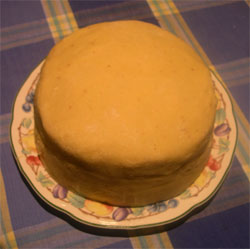
Once it is soft, roll it out to a thickness of 4mm (I use two wooden sticks from a DIY store to ensure an even thickness - they can also be used for pastry, biscuits etc). Place the serving plate or cake board on top of an upturned bowl, then carefully lift the fondant and drape over the cake, pushing upwards when smoothing the sides (at first just a little to keep in place), to prevent cracking. Trim the excess with a blunt knife, then carefully smooth the top and sides with the palm of your hands (dusted with a little icing sugar and cornflour if you want to), until shiny and smooth. If there are any cracks, smooth them the best you can, and then you can hide them with the other decorations. Wrap a ribbon around the base to hide any imperfections and secure in place with the end of a cocktail stick or a sterlised pin. Alternatively, you can roll out a long sausage of fondant in a contrasting colour, or use small balls of fondant - for this you will most likely need more than the amounts stated above. Ideally leave overnight in a cool place to dry (no need to cover, and don't put it in the fridge, as the fondant will go soggy).
On the final day, stick the flowers on the cake using a clean brush (I have a fine paint brush that I use only for cake decorating) dipped in a little vodka. I find this better than water (you can use water if not drying out the fondant in between, but you get a much better result with the drying stages, and it also divides up the work! If the flowers are not dry, they may bend when you lift them onto the cake, and you also risk leaving coloured marks if you need to reposition them. WIth dry ones, you can work out your design before sticking them in place).
Once the cake is completed, keep it in a cardboard box, or a tin, but not in a tupperware container. Keep in a cool place but, again, not in the fridge. Once cut, it will keep for another week, just cover the cut parts in foil, and keep in the same box or tin.
Chef's Tips
Fondant icing is also sometimes called sugar paste.
This is for a 15 - 18 cm cake and quantities are an estimate. For a larger cake, you will need at least half again, and possibly up to double. If in doubt, buy more fondant rather than less, as it keeps for ages if wrapped tightly in a plastic bag.
Instead of jam, you can use a 'crumb coat' of buttercream or ganache. If using white fondant, a pale buttercream or white chocolate ganache is best. To see how to make a white chocolate ganache, look up my recipe for Chocolate mud cake.
A traditional fruit cake can be decorated in the same way, but you will need a layer of marzipan between the jam and the fondant icing. It will keep in a tin for at least a month, if the cut parts are covered with foil.
Any shaped cutters can be used. Circles of different sizes are simple and effective, as are stars. If using standard cookie cutters, rather than 'plunger' cutters, dip the sharp base in a mixture of cornflour and icing sugar to help make it easier to get the fondant out. It is difficult with very small shapes, unless using 'plunger' cutters. (I purchased a set of 4 flower 'plunger' cutters for £3.50 from my local kitchen / baking shop. They are also available online, including Amazon).
If making more than one tier, you will need to buy 4 wooden or plastic struts (per tier), poke them into the cake, in a square or diamond shape in the centre, and place the second tier on top, on a lightweight cake board. I suggest fruit cake or mud cake on the bottom tier, as they are the strongest, and Madeira on top.
Similar Recipes
View all similar


Look awesome! I love the touch of using Vodka!
Look awesome! I love the touch of using Vodka!