
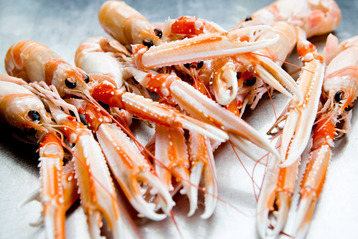
Battered Dublin Bay Prawns

Ingredients
- 12 Dublin bay prawns, King Prawns can also be used for this recipe
- ¼ cup milk
- 2 tablespoons seasoned flour
- 1 cup plain flour
- ¼ to ½ cup of light beer
- 1 medium egg
- Oil, for deep-frying
- lemon wedge and parsley, for garnish
Accompaniment
Sponsored
Nederburg Cabernet Sauvignon Rose
This beautiful rose wine is made entirely from Cabernet Sauvignon grapes, fruit driven, refreshing with abundance of berry flavours and a pleasant long finish.
Description
Succulent Dublin bay prawns coated with a light beer batter deep fried to a golden colour, serve with a garlic mayonnaise to dip
Method
-
1
Remove the heads and shell from the prawns, leaving the tail intact, slit down the back of the prawn, and remove the centre vein.
Sift the flour into a bowl, beat the egg and milk together, blend, and stir the flour to form a smooth paste add enough beer to form a batter consistency and leave to stand for 30 minutes.
Heat the oil for frying in a deep, heavy based pan toss the prawns in seasoned flour to season the flour add a sprinkling of salt and white pepper to plain flour. and dip into the batter one at a time.
Lower six prawns carefully into the oil and cook for 2 minutes, or until golden brown remove the prawns with slotted spoon and drain well on kitchen paper, and keep warm.
Cook the remaining prawns, and drain well serve on a warm serving plate and garnished with parsley sprigs and lemon wedges.
Do not cook more than six prawns at once as this will lower the oil temperature and cause prawns to absorb excess oil.
Serve and Enjoy!
Chef's Tips
Although available all year round the best season for these succulent treasures of the sea is April, May, June. July, August, September, and October.
Langoustine, Scampi Or Dublin Bay Prawn, According to the Larousse Gastronomique, the Dublin Bay prawn is known in French as "langoustine”, while in Britain the shelled tail meat is generally referred to as "scampi”. The term "prawn" can be confusing since it is used to describe several varieties of shellfish: the first group includes members of the lobster family such as the Dublin Bay prawn (langoustine in French and langostino in Spanish), Danish lobster, Italian scampi, etc., while the second takes in large shrimp, particularly those that live in fresh water.
An edible crustacean, Nephrops Norvegicus, of the order Decapoda, which is commercially sold as scampi, similar to a large prawn, it has a slender pinkish body, up to 7.87 in long, with long claws. It is widespread in the Mediterranean and NE Atlantic, living in sandy burrows at a depth of 10 to 12 ft. Dublin Bay prawns are usually fished by trawling and are marketed fresh, frozen, or cooked, shelled or unshelled, whole or as tails.
Can be cooked whole as a lobster and served cold with mayonnaise or the peeled, uncooked tail meat. They are delicate and need to be poached only for a few seconds in court bouillon. Unlike the rock lobster or spiny lobster (called "langouste" in French), or even shrimp, the Dublin Bay prawn changes colour little during cooking. It is better to undercook it rather than overcook it, so that it does not become tough and dry. When very fresh, Dublin Bay prawns have an outstanding slightly sweet flavour that is lost when they are frozen. They can be eaten plain, accompanied by melted butter. In North America, it is common to coat Dublin Bay prawns with breadcrumbs and butter and cook them briefly under a very hot grill/broiler.
Similar Recipes
View all similar


Comments (0)